
The Return of Flax: What Linen Can Teach Us About Rebuilding Canada’s Textile System
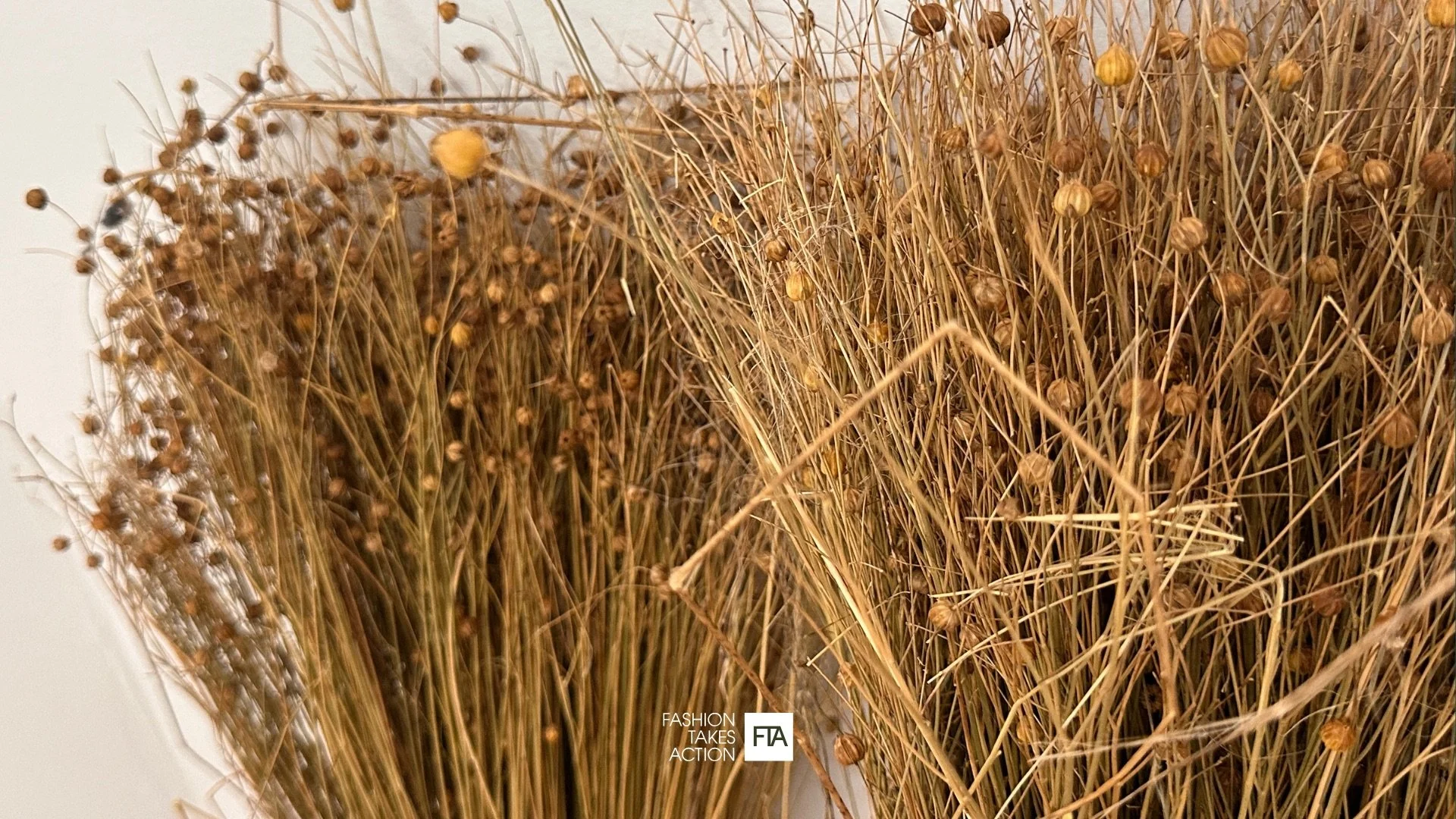
In April, members of FTA’s team joined researchers, farmers, designers, and industry partners in Halifax for a workshop at NSCAD University focused on flax - the plant that gives us linen. Supported by the Social Sciences and Humanities Research Council (SSHRC), the workshop was hosted by the Flax Fibre to Fabric research group comprising eight research leads from four different Universities.
But the conversation quickly became about much more than this single fibre.
Flax pointed us to what Canada’s textile system once included, and what may still be possible to rebuild.
A Fibre Canada Once Knew Well
Before textile supply chains became so globalized, Canada had a much closer relationship with the materials we used to make clothing and textiles.
Flax was part of that story. In 1914, Canada had about 4,000 acres of fibre flax under cultivation; by 1918, that had grown to roughly 20,000 acres.
It could be grown locally, processed regionally, spun into linen, worn, repaired, reused, and eventually returned to the earth.
Over time, that system faded. Processing infrastructure declined, technical knowledge was lost, manufacturing moved offshore, and natural fibres like flax were replaced by cheaper, faster alternatives.
Today, even when flax is grown here, it often has to leave the country to be processed. That means Canada loses both value and opportunity early in the chain.
Could Flax Be Making A Come Back?
Flax, we are realizing, represents something the current textiles system is missing.
It can be grown regionally. It can support lower-impact material pathways. It is biodegradable under the right conditions. And it has potential uses well beyond clothing.
But renewed interest in flax is not just about sustainability. It is about rebuilding capability.
Through NSCAD’s quarterly workshop, something became clear: bringing flax back is not about reviving a single crop. It is about rebuilding the system around it.
The Missing Middle
One of the biggest challenges discussed was not only farming or design, but everything in between.
Canada currently lacks much of the infrastructure needed to turn flax into finished textiles at scale, including scutching, spinning, knitting capacity and wet spinning infrastructure. There are also gaps in technical expertise.
This means that even high-quality fibre can lose value if it is not processed properly.
In other words, we do not just need to grow flax. We need to build a system that allows it to become something useful, valuable and lasting.
Beyond Linen
One of the most compelling ideas explored in the workshop was how flax could support multiple industries at once.
The long fibres can be used for textiles like linen, while the shive can be used in construction materials such as insulation, panels and low-carbon wall systems. Residual materials may have potential in paper or biochar applications.
This matters because a viable flax system cannot depend on one market alone. It needs several pathways that can use different parts of the plant and support a stronger business case.
A Regional Opportunity
What makes flax especially interesting in Canada is its potential to anchor regional systems.
The discussion in Halifax pointed to a model that includes local farming and processing, regional manufacturing, repair and reuse, and eventual reintegration through pathways such as composting.
In Atlantic Canada, early pieces of this model are already taking shape, with farmers engaged and payment structures emerging for flax straw.
This is not only about circular fashion. It is also about regional economic development.
What It Will Take To Succeed?
If flax is going to thrive in Canada again, we need to be clear about what is missing.
We need investment in processing infrastructure. We need demand from buyers, not only in fashion but also in construction, paper and other sectors. We need data, standards and carbon accounting frameworks. And we need policy and procurement to help create the conditions for these markets to grow.
Most importantly, we need to stop treating materials as isolated solutions.
Flax will not succeed simply because it is a better fibre. It will succeed if farming, processing, manufacturing, markets and policy are designed to work together.
More Than a Comeback Story
Flax is often framed as a return to something we once had.
But the opportunity now is not to recreate the past. It is to build something better.
A Canadian flax system could help us value materials differently, support regional economies, reduce waste and reconnect what we grow with what we make locally.
The real lesson from flax is not just about linen. It is about what it takes to rebuild a sustainable textile system that actually works.
This is exactly the kind of systems-level collaboration the CCTC (Canadian Circular Textiles Consortium) was created to support, helping move Canada from isolated solutions toward coordinated action across the full textile value chain.
The CCTC is currently exploring Made-in-Canada Solutions across a range of natural fibres, not just flax. Rather than simply promoting these materials, the project aims to assess whether Canada has, or could realistically develop, the infrastructure, coordination, market conditions, and economic viability needed to support circular systems for natural fibres at scale.
